Monday, August 17, 2009

Why I use Twitter

I just read a post by Devin Coldewey about why he doesn't use Twitter. Of course everybody is entitled to their opinion on what they think about a product or service, hence this is my opinion on why Twitter has a place, adds value, and is as complete as a service really needs to be.

Until February/March of this year I think, I didn't use Twitter nor believe in why I would but I then decided to give it a fair try.

Why Tweets have value?

At first, 140 characters may seem too little space to express any single idea, but after using Twitter for a few months I came to realize I really don't need that much more space to express any single thought. Think of it as an elevator pitch. If I can't grab someone's attention in the first 140 characters what makes me think I can in 4 paragraphs?
Twitter in my opinion makes you a better writer and teaches you to express your ideas in the most efficient way possible.

When I scan my feed on my phone or at a computer I'm not really reading every word in the tweet. I quickly scan through and stop when a keyword catches my eye. With a blog I have more text to scan, plus how would I even find the blog post in the first place? And with the shear amount of content on the web, I appreciate the fact that I am harvesting what others found interesting. I might not be interested in everything they tweet, but I followed them for a reason - i.e. I found them more or less interested in the same topics I am.

Twitter is as complete as it needs to be

Sure, people want A+B+C, but nobody said Twitter has to be everything for everybody. Twitter does A really well and leave B and C for others to do just as good. I am a strong believe that if you can't get the basics right, then there is no point to attempt at providing B and C. And when you have the basics nailed, why ruin it by expanding scope? Twitter is not fundamental, but it is simple and gets the job done. I used to scan blogs I follow in the morning before heading to work, now I am exposed to a larger base of articles and tweets where I am able to quickly pick out what I am interested in reading at that point. The problem with following blogs is that most of the time you won't find something interesting on them every day, you will on Twitter.

Why Facebook status updates are nothing like Twitter feeds?

This will probably change after the recent acquisition of FriendFeed by Facebook, but until it does Facebook status updates is very different and is used for different reasons. I would argue that Facebook in fact is pure vanity, I agree Twitter is too to some degree (i.e who has the more followers? who has the coolest background, who is a connector? whose got more RTs? etc.). I wouldn't scan Facebook updates on a daily basis, I would scan Twitter updates though. Twitter is kind of like a dynamic browser and social bookmarking tool. The similarity that I have seen between both is that people are using Facebook to share funny or interesting videos in my case. If I feel like watching a funny video, I would check what has been shared on Facebook.
Another major difference is that on Facebook your interests may not be aligned with your friends as much as they are with the people you follow on Twitter. For example, I got an iPhone a month ago and would like to know what applications people recommend I download. I can easily follow 20 people that talk about the iPhone and find out, how do I find such people on Facebook? and after I do I need to befriend them to be able to see their updates.

Twitter isn't supposed to replace anything, but it definitely adds a lot to certain people - and for me at least it replaced reading online news. Facebook's feed as this stage is nowhere near a competitor to Twitter. Their uses overlap in some areas but in my opinion are disjoint in most areas. Certain things are better shared on Facebook, ex. a picture of friends at your birthday party, other things are better shared on Twitter ex. a link to a specific topic that interests a fraction of your Facebook network, but much more on your Twitter network.

Twitter as a news aggregator

Twitter is a great aggregator, and works great aggregating news which explains why traditional media hopped on it. I didn't learn about Michael Jackson's death on Facebook, nor did I learn about it on CNN, I read it on Twitter. I confirmed it on CNN though and then on Facebook I saw friends' recollections of his greatest moments. On the Iran fiasco, I learned that through Twitter as well, unfortunately that weekend the media dropped the ball and I couldn't confirm any of it, but the fact that so many people were 'reporting' on it in real-time was enough to give it credibility.

Twitter became pure vanity

One thing that disappointed me about Twitter is how fast it got flooded with "experts" and "gurus", there is an expert on every imaginable topic on Twitter - obviously not all legit or credible sources of information. But I am guilty of this as well, I described myself as a "Google Maps Guru".
For me at least, I don't follow many people who just promote themselves i.e. the whole "I just ate an apple....yum" crowd - unless I know them in person or they usually share stuff that interests me. But this is the great thing about its simplicity, if I want to do some sort of social experiment about how often people post when eating an apple, Twitter would be my source for that info.

My daily dosage of tweets come from other Google maps developers, the different Google products teams, friends, legit SEO experts, news aggregators, the media and some miscellaneous people that I found interesting via RTs, FollowFridays or followers.

I agree, our attention is spread so thin these days, but because of that, if it weren't for Twitter's 140 characters could it have worked at all?

Thursday, June 04, 2009

On Guaranteed SEO Results: Have I got a deal for you

A search for "guaranteed SEO" on Google returns about 5,300,000 results. On the first page alone 6/10 results mention the word "Google". So this begs the question, is there such a thing as "guaranteed SEO"? Let's find out.
According to Matt Cutts Google ranks pages according to relevance and reputation. Why should you believe him? well because he is the head of the Google Webspam team. When it comes to search; Google Search, Matt Cutts is the man to listen to. So listen to him.

Reason 1: You can't become relevant over night
Being relevant is something you acquire over time. Measuring relevancy is something that gets tweaked over time. So by nature Google's ranking algorithms will and must change over time to maintain relevant rankings and improve their measure of relevancy. So how can you, you or you guarantee relevancy? I can promise you the sun will rise from the east tomorrow (if it didn't then SEO is the last thing on anybody's mind), but can anybody promise you a million dollars tomorrow? Sure someone can; somebody very generous and with a million dollars to give away. For SEO that generous billionaire would be Google, but then if they do, can they remain relevant? You get my point.

Reason 2: You can't become reputable the next day
Building any reputation takes time; even a bad reputation. Your website's reputation is critical for ranking on the SERPs. The more PageRank the higher you rank. You get more PageRank by getting inbound links from others with high PageRank. Quality over quantity. 1 million times zero is still zero.

Reason 3: Because Matt Cutts said so
According to him, the best SEO strategy is adaptive SEO. Just like any optimization algorithm, you make gradual improvements and take a measurement against the objective function. Rinse and repeat, but don't get overly obsessed with it; quit when you hit the point of diminishing returns, then try something else. 
This process obviously takes time and research. But thanks to Google they give you all the tools and information you need to rank high on the SERPs.

For my blog I follow three simple rules:
  1. When I write about something, I put myself in the shoes of someone looking for the information I am about to write on. I make a list of these keywords and naturally include them in my post.
  2. Every month I use Wordle.net to generate a tag cloud of my blog. This gives me a good idea about the keyword distribution and whether I have enough keywords on the topics I would like to rank high on.
  3. I make sure each of my posts' URLs contain the main keywords. This step is crucial.
With these three steps, I rank pretty well on some topics:


Now, have I got a DEAL for you... : )


Monday, June 01, 2009

On the GM bankruptcy: Stay small, think big

Today GM files for bankruptcy protection in an effort to "create a leaner, quicker more customer and completely product-focused company, one that's more cost competitive and has a competitive balance sheet," according to CEO Fritz Henderson. What happened today is only a sequel to many previous episodes where big companies have failed big. Remember Enron? Air Canada? American Airlines? Circuit City? Lehman Brothers? Washington Mutual? WorldCom? Chrysler? Texaco?

Ironically the terms GM CEO Henderson described the future of GM as are "leaner", "quicker", "customer focused", "product focused", and "competitive" which are some of the terms that describe small companies today, in the present not in the future - and after filing for bankruptcy protection.

Too Big To Fail?


Although it is probably applicable for many industries, with regards to technology firms, is small the new big? Why do extra large IT firms lack the creativity and drive to implement the cool applications of today? Why are these cutting edge and innovative applications being created in basements and college dorms nearby by a handful of people? Think Google, Facebook and Twitter for example.

Before the Internet it paid to be big. Big sales team, big headquarters, big advertisements, big, big, big, big and big. Yes I'm talking about economies of scale. Today though, are economies of scale as important as they used to be? Probably not otherwise these big companies such as GM and Enron would not have failed big since they supposedly enjoyed big economies of scale. "Too big to fail" is now a myth of the past. You don't need an army of developers and IT professionals to build successful applications used by millions.


Tuesday, May 26, 2009

Hyperlocal News - Personalized News For You

With online services like Animotto, Flickr, Blogger and Twitter almost anybody can be a video producer, photographer, journalist or news reporter- no degrees or formal training required. With these new mediums the average person can create and distribute their content with virtually no barriers to entry. This major shift gave rise to terms like hyperlocal and citizen journalism


Hyperlocal is relevant


Hyperlocal news is news relevant to small communities. Think a modern neighborhood flyer or newsprint where anybody can submit content such as videos, pictures, articles or even just their opinions and comments. In the 90s as the internet spread widely, forums and blogs started popping out all over the web to cater to different communities be it virtual or physical ones. 
The big news companies took notice of this shift and started providing their own mediums for hyperlocal. These include services like CNN's iReport or The Weather Channel's photo submission. What about the newspapers? how are they coping with these changes and in an uncertain economy?  

Once upon a time printed newspapers were extremely popular and they utilized techniques today's websites still use to promote themselves, increase traffic, and keep users on page longer. Sounds familiar? yes these are the same goals every person involved in SEO wants to achieve. Why else do you think that comic strip or crossword puzzle was printed in your favorite newspaper?

Hyperlocal feeds our thirst for news


Newspapers are dying, but people still want news. Our thirst for information has not decreased, if anything it increased beyond belief. The change is, people want to choose what news they want. I never read the stock pages and charts in a printed paper; I rarely read the finance paper and if I do its limited to the front page - so why should it be delivered to me? 
The case for hyperlocal news is just getting stronger so perhaps these major newspapers will break off into smaller hyperlocal news outlets. Maybe a visit to NYTimes.com will render a page like NYTimes.com/Jersey? This is if they wake up and stop being in denial. 

Hyperlocal is context aware, and of course location aware


Location is a key component for personalization and its possibly the easiest piece of information one can extract from their visitors and deliver personalized content. With hyperlocal news it makes complete sense to me to present it on a map instead of a traditional newspaper-ish view. And with the popularity of mobile devices this strengthens the reasons for a hyperlocal news map. Consider this, you are stuck on a highway and pick up your iPhone to turn on this hyperlocal news map. You get to see where you are right now and what stories are going on around you. The exit is coming up and you are considering escape, but your hyperlocal news map is reporting that a group of chimps have escaped the local zoo and are sitting on the highway barrier 'entertaining' the traffic which is causing all the delay. Now that is something that you don't see on a regular day on the highway, maybe you won't get off that exit after all?

Thursday, May 21, 2009

Referential Integrity: honesty is the best SEO policy

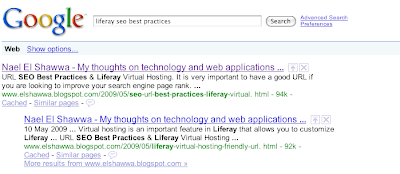
What does it mean to provide something that is relevant, precise, and efficient? The common factor between these terms is the truth and nothing but the truth. Google defined the rules for this game; they want to help you rank higher, but you need to play by the rules. If you do so you get rewarded by PageRank i.e. your pages will rank higher on the search terms that you want. Try to cheat the system and you will get punished. Google does not assign these search terms for you, you pick them; its up to you to pick the right terms and follow the rules. One of my posts ranks #1 on Google for the search term "liferay seo best practices":


What does it mean for one to have 'integrity'?

According to Wikipedia 'integrity' has to do with perceived consistency in a holistic fashion. Integrity is also perceived as the quality of having a sense of honesty and truthfulness in one's actions. Integrity can be tested subjectively by one's individual methods or objectively by scientific methods. Take for example your purchasing process before paying for a product or service. Every wise purchase decision includes research. Normally you would research the products or services you are interested in and see for yourself what they say about themselves. The end product of this stage results in a list of potential products that you are considering for purchase. In this stage you are testing the product for relevance, precision and efficiency. Next comes your method to test the list of potential products for honesty. Usually one would do this by getting feedback from others who have made the 
purchase. The end product of this stage is another list of potential products - hopefully a smaller list than what you started with. You now rinse and repeat this cycle until you reach a small enough set to actually make your decision and do the purchase. 

What is 'referential integrity' ?

This term comes from relational databases. Basically it is consistency between coupled tables. The following diagram from Wikipedia shows what it means to have referential integrity and what it means to have broken referential integrity.
Although the second record of the album's table claims the album 'Eat the rich' belongs to artist #4 the actual artist's table does not confirm this claim since there is no artist #4. Hence referential integrity is broken in this case. 

How can enforcing your "website's referential integrity" reward you with more traffic?

It all starts with honesty. Do not try to write content for search engines, it does not work because it is not relevant, not precise and not efficient. Hence it is not truthful. Write content that people will find useful. There are things that you can do that are under your control; for example building references between your websites pages. There is no reason why one would not be able to do this properly. You need to be objective with these links as well; "Home" is not an objective link yet it is very common to have on a website. "Products" is not an objective link yet it is also very common to have on a website. The page title is not the only important factor, the name of the page or URL is also important; "home.html" or "products.html" is not an objective name. It is very important to have objective page names and titles - for example "What is Referential Integrity? and how can it increase your PageRank" is an objective title. "/referential-integrity-increase-pagerank.html" is an objective page name. By being careful with picking page titles and names you are already well underway in improving your ranking on search engine result pages.

A database designer knows what database normalization is. The concept behind database normalization is also applicable in writing great website copy. Basically database normalization is the process of organizing your data in an efficient way. The two main objectives are eliminating redundant data and eliminating the storage of the same data in multiple locations. With regards to website copy, it is important to aim to write copy for each page to allow that page to rank high on specific search terms without cannibalizing your other pages' rankings. This is easier said than done, especially if you are writing a blog since usually you have a certain number of topics that you write about. Eventually you will get multiple pages ranking for the same search terms as the image of my blog's ranking for "liferay seo best practices"

The second component of an SEO strategy is to proof of your integrity. At this point you have written honest and complete copy for your pages. This stage is something out of your control, but this does not mean you cannot do anything to help you in this stage. By writing honest copy you increase the chances of others finding your information complete and truthful hence increase the chances they would link to you from their websites and blogs. Social networks are extremely helpful in this stage and as I have described in an earlier post "SEO without social; Cereal without Milk". You can publicize your content on social networks such as Facebook and Twitter as I am doing right now. This helps you broadcast your content to a much larger audience, increase your traffic and eventually generate some inbound links. 

How does Google prevent SEO abuse?

The main line of defense Google has against this is their PageRank algorithm. This algorithm rewards for being truthful as well as punish you for cheating. For example if one were to create 100 fake websites to link to their company website. The PageRank algorithm shares a page's credibility with every other page that it links to. So in a case of 100 fake websites, odds are they all have a very low PageRank if not zero. This also strengthens the argument on promoting your website on social networks because of most them have a high PageRank (8 or 9) which is comparable to high profile sites such as the New York Times. Obviously it is easier to get a link on Twitter than it is to get on the New York Times and the fact that a good share will by the nature of social networks get re-shared or re-tweeted you will get far more links and faster than you can get one link up on the New York Times.

Again honesty is always the best policy - even for SEO. Understand how referential integrity works and play by Google's rules and you will be rewarded.


On the current state of online ads: Ads 3.0 - Social Aware. Context Aware. Personalized.

Mozilla Labs launched a new experiment in how one may enhance their Firefox experience using Jetpack modules. Firefox plugins have been one of the most popular features of Firefox that allows the user to personalize and customize their Firefox web experience to their needs. Jetpack may be "how Firefox might be extending web functionality in years to come" according to a TechCrunch article. This article is not about Mozilla, Firefox, plugins or even Jetpack - in fact it is just about one Jetpack example called "unAd".

The mere presence of add ons that strip out advertisements from website - which is what the Jetpack add on "unAd" does - tells a lot about the state of current online advertisement campaigns. These advertisements are basically more annoying than they are successful - otherwise people wouldn't be looking for ways to strip them out of their web experience.

In my opinion traditional marketers turned online marketers have been attempting to shoehorn their traditional marketing methods into today's online model of commerce and advertisements - this is mainly why I believe these methods are failing today. What worked in 1990 does not have to work in 2010; times change and it is about time for marketing to change.

What are the basics of marketing any marketing student learns about in Marketing 101?
Now you might think what does a software engineer know about marketing, but I did take marketing and business management as part of my Software Engineering and Management degree so at least to some extent I do know what I am talking about.
  • Grab the potential customer's attention i.e. wow them
  • Motivate them to buy i.e. click through
  • Get them to buy i.e. click through
  • Get them to buy again i.e. click through again
So basically in today's online marketing any advertisement must motivate you to click through and actually get you to do so. How is today's online ads fairing in doing this? When was the last time you actually clicked an advertisement?

Apple revealed a new web advertisement that definitely "wowed me". I first heard about it from a friend who saw it on the New York Times website a few days ago. Although it is still basically the same advertising model that has dominated the web i.e. non personalized online advertisement yet it did in a different way that captures our attention. 


This advertisement just brought the page to life, it's not personalized but its definitely new and very creative and it would have definitely grabbed my attention instantly. Frankly if an advertisement cannot distract you for 30 seconds while it delivers its message, the advertisement has failed. 

Coming from traditional mediums of advertisement (print, TV, and radio) is probably not the best background to a successful online marketer. Sure some techniques are still applicable but a lot has changed. Compare online ads with traditional TV ads. Unless you get off the couch and start surfing your channels during an ad you are forced to see the advertisements until your favorite show is back on. Note that people have been trying hard not to see advertisements; how many times have you said: "Hang on, I'll call you back during the commercial break" ?
Unfortunately for marketers, advertisements - as it stands - is a negative experience, whether it is on TV, radio, print or even the web. That is why marketers have retreated to using humor and creativity to "wow" the audience.

The next "wow" factor has got to be personalized advertisements. We have pushed the envelope on the current model to its limits; what else is there to do within the boundaries of the current model? Why isn't it time to look outside of these boundaries and think outside the box?

Today's market is no longer bounded by geography and websites have been delivering targeted advertisements for sometime now thanks to big players like Google's AdSense. For example, next time you log in to GMail, notice how the advertisements around you change based on the content of your emails. If you happen to be looking for jobs and e-mailing resumes you will get ads on resume writing, jobs, interview skills, etc. On the other hand if you are looking to buy a car, then you will get advertisements on that. Keyword advertisement is getting old though, it is still considered spam and it is not personal.

Online advertising can be made personal via all the available social networks today. Facebook has currently 200 million users; if it were a country it would be the fourth biggest country after China, India, and the USA. There is a wealth of information available on these networks. One is able to answer all these questions via the social networks: Who are you? What are you interested in? and What have you been up to? The answers to all these questions are important to be able to successfully personalized advertisements and even personalize recommendation engines on e-commerce sites. We are definitely on the path towards this age of personalized content via knowledge mined from these social networks but the question is: how long before Amazon can finally recommend a book to me next time I log in based on a conversation I have had publicly on Twitter or Facebook?

Wednesday, May 20, 2009

Navegg for behavior web analytics beyond Google Analytics

Navegg is a web based add-on just like Google Analytics but aims to report on visitor demographics and behaviors - which you cannot achieve with Google Analytics.
This information is extremely important for marketers, but it is also important if you aim to personalize your content for different users. The uses are not just limited to marke
ting as the data it gathers can and should influence your design and feature decisions as well.

I signed up for this account a few days ago and now I get access to very little demographics that I will share with you. What is confusing is that Google Analytics reports 20 unique visitors yesterday and 24 the day before yet I only see 3 on Navegg. I will probably have to revisit this in a few weeks when it has gathered more information for me.

The neat thing is that both Google Analytics and Navegg have public APIs and both so far are free services. One could potentially build their own analytics engine that combines data from both in the segments each excels at. For example I really like the Goal Funnel Visualization feature on Google Analytics, it can be made even more useful if I can see demographics on it; ex. how many single females between 22 and 28 dropped out of the sales funnel? 

Thanks to Jennifer Van Grove's post on Mashable about Navegg which got me to sign up and try it out - how else would I have known that I had 3 readers yesterday that are college graduates and males between 25 and 34 years old!