Tuesday, May 26, 2009

Hyperlocal News - Personalized News For You

With online services like Animotto, Flickr, Blogger and Twitter almost anybody can be a video producer, photographer, journalist or news reporter- no degrees or formal training required. With these new mediums the average person can create and distribute their content with virtually no barriers to entry. This major shift gave rise to terms like hyperlocal and citizen journalism. 


Hyperlocal is relevant


Hyperlocal news is news relevant to small communities. Think a modern neighborhood flyer or newsprint where anybody can submit content such as videos, pictures, articles or even just their opinions and comments. In the 90s as the internet spread widely, forums and blogs started popping out all over the web to cater to different communities be it virtual or physical ones. 
The big news companies took notice of this shift and started providing their own mediums for hyperlocal. These include services like CNN's iReport or The Weather Channel's photo submission. What about the newspapers? how are they coping with these changes and in an uncertain economy?  

Once upon a time printed newspapers were extremely popular and they utilized techniques today's websites still use to promote themselves, increase traffic, and keep users on page longer. Sounds familiar? yes these are the same goals every person involved in SEO wants to achieve. Why else do you think that comic strip or crossword puzzle was printed in your favorite newspaper?

Hyperlocal feeds our thirst for news


Newspapers are dying, but people still want news. Our thirst for information has not decreased, if anything it increased beyond belief. The change is, people want to choose what news they want. I never read the stock pages and charts in a printed paper; I rarely read the finance paper and if I do its limited to the front page - so why should it be delivered to me? 
The case for hyperlocal news is just getting stronger so perhaps these major newspapers will break off into smaller hyperlocal news outlets. Maybe a visit to NYTimes.com will render a page like NYTimes.com/Jersey? This is if they wake up and stop being in denial. 

Hyperlocal is context aware, and of course location aware


Location is a key component for personalization and its possibly the easiest piece of information one can extract from their visitors and deliver personalized content. With hyperlocal news it makes complete sense to me to present it on a map instead of a traditional newspaper-ish view. And with the popularity of mobile devices this strengthens the reasons for a hyperlocal news map. Consider this, you are stuck on a highway and pick up your iPhone to turn on this hyperlocal news map. You get to see where you are right now and what stories are going on around you. The exit is coming up and you are considering escape, but your hyperlocal news map is reporting that a group of chimps have escaped the local zoo and are sitting on the highway barrier 'entertaining' the traffic which is causing all the delay. Now that is something that you don't see on a regular day on the highway, maybe you won't get off that exit after all?

Thursday, May 21, 2009

Referential Integrity: honesty is the best SEO policy

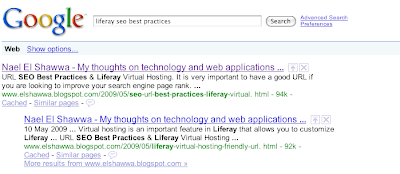
What does it mean to provide something that is relevant, precise, and efficient? The common factor between these terms is the truth and nothing but the truth. Google defined the rules for this game; they want to help you rank higher, but you need to play by the rules. If you do so you get rewarded by PageRank i.e. your pages will rank higher on the search terms that you want. Try to cheat the system and you will get punished. Google does not assign these search terms for you, you pick them; its up to you to pick the right terms and follow the rules. One of my posts ranks #1 on Google for the search term "liferay seo best practices":


What does it mean for one to have 'integrity'?

According to Wikipedia 'integrity' has to do with perceived consistency in a holistic fashion. Integrity is also perceived as the quality of having a sense of honesty and truthfulness in one's actions. Integrity can be tested subjectively by one's individual methods or objectively by scientific methods. Take for example your purchasing process before paying for a product or service. Every wise purchase decision includes research. Normally you would research the products or services you are interested in and see for yourself what they say about themselves. The end product of this stage results in a list of potential products that you are considering for purchase. In this stage you are testing the product for relevance, precision and efficiency. Next comes your method to test the list of potential products for honesty. Usually one would do this by getting feedback from others who have made the 
purchase. The end product of this stage is another list of potential products - hopefully a smaller list than what you started with. You now rinse and repeat this cycle until you reach a small enough set to actually make your decision and do the purchase. 

What is 'referential integrity' ?

This term comes from relational databases. Basically it is consistency between coupled tables. The following diagram from Wikipedia shows what it means to have referential integrity and what it means to have broken referential integrity.
Although the second record of the album's table claims the album 'Eat the rich' belongs to artist #4 the actual artist's table does not confirm this claim since there is no artist #4. Hence referential integrity is broken in this case. 

How can enforcing your "website's referential integrity" reward you with more traffic?

It all starts with honesty. Do not try to write content for search engines, it does not work because it is not relevant, not precise and not efficient. Hence it is not truthful. Write content that people will find useful. There are things that you can do that are under your control; for example building references between your websites pages. There is no reason why one would not be able to do this properly. You need to be objective with these links as well; "Home" is not an objective link yet it is very common to have on a website. "Products" is not an objective link yet it is also very common to have on a website. The page title is not the only important factor, the name of the page or URL is also important; "home.html" or "products.html" is not an objective name. It is very important to have objective page names and titles - for example "What is Referential Integrity? and how can it increase your PageRank" is an objective title. "/referential-integrity-increase-pagerank.html" is an objective page name. By being careful with picking page titles and names you are already well underway in improving your ranking on search engine result pages.

A database designer knows what database normalization is. The concept behind database normalization is also applicable in writing great website copy. Basically database normalization is the process of organizing your data in an efficient way. The two main objectives are eliminating redundant data and eliminating the storage of the same data in multiple locations. With regards to website copy, it is important to aim to write copy for each page to allow that page to rank high on specific search terms without cannibalizing your other pages' rankings. This is easier said than done, especially if you are writing a blog since usually you have a certain number of topics that you write about. Eventually you will get multiple pages ranking for the same search terms as the image of my blog's ranking for "liferay seo best practices". 

The second component of an SEO strategy is to proof of your integrity. At this point you have written honest and complete copy for your pages. This stage is something out of your control, but this does not mean you cannot do anything to help you in this stage. By writing honest copy you increase the chances of others finding your information complete and truthful hence increase the chances they would link to you from their websites and blogs. Social networks are extremely helpful in this stage and as I have described in an earlier post "SEO without social; Cereal without Milk". You can publicize your content on social networks such as Facebook and Twitter as I am doing right now. This helps you broadcast your content to a much larger audience, increase your traffic and eventually generate some inbound links. 

How does Google prevent SEO abuse?

The main line of defense Google has against this is their PageRank algorithm. This algorithm rewards for being truthful as well as punish you for cheating. For example if one were to create 100 fake websites to link to their company website. The PageRank algorithm shares a page's credibility with every other page that it links to. So in a case of 100 fake websites, odds are they all have a very low PageRank if not zero. This also strengthens the argument on promoting your website on social networks because of most them have a high PageRank (8 or 9) which is comparable to high profile sites such as the New York Times. Obviously it is easier to get a link on Twitter than it is to get on the New York Times and the fact that a good share will by the nature of social networks get re-shared or re-tweeted you will get far more links and faster than you can get one link up on the New York Times.

Again honesty is always the best policy - even for SEO. Understand how referential integrity works and play by Google's rules and you will be rewarded.


On the current state of online ads: Ads 3.0 - Social Aware. Context Aware. Personalized.

Mozilla Labs launched a new experiment in how one may enhance their Firefox experience using Jetpack modules. Firefox plugins have been one of the most popular features of Firefox that allows the user to personalize and customize their Firefox web experience to their needs. Jetpack may be "how Firefox might be extending web functionality in years to come" according to a TechCrunch article. This article is not about Mozilla, Firefox, plugins or even Jetpack - in fact it is just about one Jetpack example called "unAd".

The mere presence of add ons that strip out advertisements from website - which is what the Jetpack add on "unAd" does - tells a lot about the state of current online advertisement campaigns. These advertisements are basically more annoying than they are successful - otherwise people wouldn't be looking for ways to strip them out of their web experience.

In my opinion traditional marketers turned online marketers have been attempting to shoehorn their traditional marketing methods into today's online model of commerce and advertisements - this is mainly why I believe these methods are failing today. What worked in 1990 does not have to work in 2010; times change and it is about time for marketing to change.

What are the basics of marketing any marketing student learns about in Marketing 101?
Now you might think what does a software engineer know about marketing, but I did take marketing and business management as part of my Software Engineering and Management degree so at least to some extent I do know what I am talking about.
  • Grab the potential customer's attention i.e. wow them
  • Motivate them to buy i.e. click through
  • Get them to buy i.e. click through
  • Get them to buy again i.e. click through again
So basically in today's online marketing any advertisement must motivate you to click through and actually get you to do so. How is today's online ads fairing in doing this? When was the last time you actually clicked an advertisement?

Apple revealed a new web advertisement that definitely "wowed me". I first heard about it from a friend who saw it on the New York Times website a few days ago. Although it is still basically the same advertising model that has dominated the web i.e. non personalized online advertisement yet it did in a different way that captures our attention. 


This advertisement just brought the page to life, it's not personalized but its definitely new and very creative and it would have definitely grabbed my attention instantly. Frankly if an advertisement cannot distract you for 30 seconds while it delivers its message, the advertisement has failed. 

Coming from traditional mediums of advertisement (print, TV, and radio) is probably not the best background to a successful online marketer. Sure some techniques are still applicable but a lot has changed. Compare online ads with traditional TV ads. Unless you get off the couch and start surfing your channels during an ad you are forced to see the advertisements until your favorite show is back on. Note that people have been trying hard not to see advertisements; how many times have you said: "Hang on, I'll call you back during the commercial break" ?
Unfortunately for marketers, advertisements - as it stands - is a negative experience, whether it is on TV, radio, print or even the web. That is why marketers have retreated to using humor and creativity to "wow" the audience.

The next "wow" factor has got to be personalized advertisements. We have pushed the envelope on the current model to its limits; what else is there to do within the boundaries of the current model? Why isn't it time to look outside of these boundaries and think outside the box?

Today's market is no longer bounded by geography and websites have been delivering targeted advertisements for sometime now thanks to big players like Google's AdSense. For example, next time you log in to GMail, notice how the advertisements around you change based on the content of your emails. If you happen to be looking for jobs and e-mailing resumes you will get ads on resume writing, jobs, interview skills, etc. On the other hand if you are looking to buy a car, then you will get advertisements on that. Keyword advertisement is getting old though, it is still considered spam and it is not personal.

Online advertising can be made personal via all the available social networks today. Facebook has currently 200 million users; if it were a country it would be the fourth biggest country after China, India, and the USA. There is a wealth of information available on these networks. One is able to answer all these questions via the social networks: Who are you? What are you interested in? and What have you been up to? The answers to all these questions are important to be able to successfully personalized advertisements and even personalize recommendation engines on e-commerce sites. We are definitely on the path towards this age of personalized content via knowledge mined from these social networks but the question is: how long before Amazon can finally recommend a book to me next time I log in based on a conversation I have had publicly on Twitter or Facebook?

Wednesday, May 20, 2009

Navegg for behavior web analytics beyond Google Analytics

Navegg is a web based add-on just like Google Analytics but aims to report on visitor demographics and behaviors - which you cannot achieve with Google Analytics.
This information is extremely important for marketers, but it is also important if you aim to personalize your content for different users. The uses are not just limited to marke
ting as the data it gathers can and should influence your design and feature decisions as well.

I signed up for this account a few days ago and now I get access to very little demographics that I will share with you. What is confusing is that Google Analytics reports 20 unique visitors yesterday and 24 the day before yet I only see 3 on Navegg. I will probably have to revisit this in a few weeks when it has gathered more information for me.

The neat thing is that both Google Analytics and Navegg have public APIs and both so far are free services. One could potentially build their own analytics engine that combines data from both in the segments each excels at. For example I really like the Goal Funnel Visualization feature on Google Analytics, it can be made even more useful if I can see demographics on it; ex. how many single females between 22 and 28 dropped out of the sales funnel? 

Thanks to Jennifer Van Grove's post on Mashable about Navegg which got me to sign up and try it out - how else would I have known that I had 3 readers yesterday that are college graduates and males between 25 and 34 years old!

Monday, May 18, 2009

Lessons learned from Gordon Ramsay

Ever watched an episode of Kitchen Nightmares? I mainly got into it because of the similarities between running a kitchen  Gordon Ramsay style and how a lot of software processes could look at Gordon Ramsay for direction.

Ramsay's kitchens are agile kitchens and if his kitchens followed a waterfall model like many software teams do then you would end up getting your food at 2am after arriving for supper at 6pm. Anyway that is not the topic of this post, but you can read more on this at Clinton Begin's Blog.

Can you become successful by being average?

What makes a good dish a great one?
Every ingredient in a great dish is there for a very specific reason, there is not 1 unnecessary ingredient. Nothing is out of place and each element captures a component of the dish's essence.
Presentation, presentation, presentation. That is the second element of a great dish. A great dish is inviting, once you see it you already know how you are going to 'attack it' and you are not left confused where to start.

Why simple works better?


A good software engineer says "No" more than they say "Yes"
Cooking a great dish requires a lot of discipline; building great software also requires great discipline. It is very tempting to just add more ingredients or more features into a dish or software, but that temptation needs to be resisted; someone needs to act like a referee and reject anything that does not add value. Just because you can, does not mean you should. As a software consultant I always find myself facing customers that want everything under the sun in their application. They want everybody and I mean everybody to use it for everything. There are many problems with this philosophy, mainly you end up with a very cluttered software where it's main essence has been diluted. This is where I find myself asking over and over again What value does that feature add? Who does it benefit? How many will benefit from it? Keep in mind that 80% of your revenue is generated by 20% of your customers.

Gordon's cooking style is simple, and whenever he walks in to a failing kitchen he ends up simplifying and idiot proofing the menu more than anything else. A lot of restaurants fall into the trap of trying to satisfy all their customers even if doing so takes away from the restaurant's essence. This seems to be a common mistake amongst all restaurants shown on Kitchen Nightmares. Surprisingly lessons learned from these failing restaurants can be applied to failing software as well. One episode I remember is the case of an "authentic" Indian restaurant in Notting Hill that had french fries on their menu! Yes french fries in an "authentic" Indian restaurant. The owner's flawed reasoning is because some customer's wanted french fries. This is a simple example where discipline was required and if the customer wanted french fries they can go to the nearest McDonald's or KFC - not an "authentic" Indian restaurant. If it goes on the menu it will be ordered, but don't trick yourself into thinking just because it was ordered or used then there was demand for it.
I am a true believer that doing one thing great is better than doing a half assed job on 10 things. I hear the phrase "Jack of all trades" often in the software / consulting industry I don't particularly like it because it literally means you are not exceptionally good at anything, just average in many things i.e. "Jack of all trades; master of none". I don't see anything to boast about there. Don't get me wrong, there is nothing wrong with knowing a lot of trades, but everybody needs one or two trades where they are really good - and I mean really. So can you make a career for yourself out of being a "Jack of all trades" - I don't think so. 
In his book Malcolm Gladwell talks about the 10,000 hour rule where for one to call themselves an expert at anything they need to have done that for at least 10,000 hours. Consider one who works an average work week of 40 hours and no weekends, it would take you 5 years of doing nothing but that one thing to become an expert at it. If you are a "Jack of all trades" then it could take you 10 years, 20 years or maybe even a life time before you become an expert at any one of these trades. Point is, it is very easy to be a "Jack of all trades" but it is difficult to be a "master of one"; so focus on a few things or ingredients and become really good at delivering these ingredients together. Now you have a unique selling point. Next time remember this when you are just about to describe yourself as a "Jack of all trades".

Presentation is the second criterion for great dishes and excellent software. Making 12 features look awesome is always an easier and simpler task than making 120 look okay. Get the basics right first and then build from there. If you mess up on the basics, you really don't have a chance.

So how can you tell the difference between an excellent dish and an average one if all you have been tasting are average dishes?


SEO without social; Cereal without Milk

How does a bowl of cereal without milk sound? Some do it but you are always left with an extremely bugging question "Why?"

SEO, SEM & SERPs - The Whats, Whys and Hows?

Search Engine Optimziation according to Wikipedia is the process of improving the volume of traffic to a website from a search engine (aka Google) via organic results. Actually it is not just limited to Google, but if you don't exist on Google's SERPs (Search Engine Result Pages) then do you exist at all?
Search Engine Marketing according to Wikipedia is the process of promoting a website by increasing visibility on said SERPs via paid methods or contextual advertisement. In my opinion paid methods are for websites that want the easy way out; my advice is do it right and focus on content and context.

So how is this all tied to the Social Web? Let us start with Web 3.0; a concept in which the semantics of the web are defined. In other words the Semantic Web is an extension to today's Web that make it possible the exchange of data, information and knowledge (aka sharing). But wait how can I define Web 3.0 without mentioning its older brother Web 2.0? Well the fundamental reasons behind Web 2.0 is to facilitate collaboration, sharing, and interoperability of information on the web. Web 2.0 is by no means fancy design and cool buttons; Web 2.0 is a mentality and a philosophy and without understanding the fundamental reasons behind it do not throw the term around loosely. 
Today a lot of people equate Web 2.0 with a certain look. You must have heard the phrase "web 2.0 look and feel" or "web 2.0 design" but unless the design includes elements to enhance sharing and facilitate collaboration then it cannot be identified as a member of the Web 2.0 family. "Web 2.0 look and feel" reminds me of a computer salesmen that went ahead to explain what 2GB RAM means to me and his explanation was that 2GB RAM allows me to run multiple applications at once - as opposed to my 1 GB RAM machine at the time that allowed me to run one application at a time? Yes that is what "web 2.0 look and feel" reminds me of - a terrible sales pitch. It definitely sounds better than "cool look and feel" and since so many people are throwing the term loosely here and there then it is very easy to throw it around ourselves. Don't; nothing will make you look worse than trying to sell something to a potential customer where they know just enough about this than your explanation implies about you.

SEO & Social - Please put some milk on my cereal

Okay so how does this all fit together in the big picture? Remember we talked about Google SERPs, content and context to improve the volume of traffic to your site? Well the Social Web provides you with a tremendous opportunity to generate fresh content and add context to your site. By joining the Social Web be it Twitter, Facebook, Digg, Del.ici.ous, Stumble Upon, Flickr, and using the tons of applications that enhance your Social Web productivity you are generating a lot of indexable and shareable content. Your investment will pay off when you notice you are still getting more traffic on weekends than you did on weekdays prior to joining.

With the rise in popularity of SEO many companies have sprung up that claim to be SEO professionals and claim to have a 'fool proof' strategy. First be very wary of companies that claim a 'fool proof' strategy for anything that is as volatile as the web. Ranking algorithms change frequently to battle such companies and their claims. Second, if their 'fool proof strategy' does not include a Social Media strategy then walk away because SEO without Social is like leaving money on the table and who wants to do that? Besides on top of leaving money on the table you are paying them for half a supposedly 'fool proof' strategy. Would you buy a car and leave the wheels at the table?

Corporate 2.0 - Humanize the brand

Times have changed, and corporate websites need to catch up - and they already started to. Again Corporate 2.0 is just like Web 2.0, it is not just a look & feel. It is in fact a complete overhaul of the web, marketing and strategies - and an overhaul to the internal work philosophies in favor of more transparent communication between employees that allow the company to capture, store and manage all the intellectual property generated from these internal communications. 
The days of talking about me i.e. the corporation are long gone. Customers expect to find you participating in the Social Web, and to really be on there corporations need to come down a notch and put human faces on the brand. The days of hiding behind a logo or a "we" are also gone. Twitter accounts, blogs, profiles, pictures, comments, ratings, videos,  Screencasts, Youtube, are all important building blocks of a corporation's web and sales strategies.

For example let us consider the sales technique of "cold calling" and how Twitter is a better technique. By definition this method is "cold" yet it is one of the most popular tools in a salesperson's toolbox. Is it even effective? What is the success ratio? 
Briefly, Twitter is a better tool mainly because after you have a built a community by contributing and not just marketing yourself you can easily approach these members of your community - your followers. These individuals and companies have pretty much subscribed to your content because they found it interesting - they could also be automated marketing bots that follow anything under the sun so don't get too excited. Anyway, so real "Twitterers" have subscribed to your content  - you are already in the door. You don't need to sell them right away - actually do not do that as one of my favorite people on Twitter @theexpert says "It's eConVERSE before eComMERCE". This micro-blogging site allows you to contact anybody with a public account and direct a 140 character message at. Not only would they notice it, but also other people will too. So even if the 30 seconds you invested in formulating that 140 character message does not bare any fruit from this person, your 30s investment is not just visible by that one person, it is visible for all to see. This is a priceless fact.

Corporate 2.0 also includes usage of crowd-sourcing i.e. you allow your community to do some work for you. This is a very natural result of joining the Social Web. People will share, comment, rank, digg, like, stumble, re-tweet, debate, criticize, discuss and collaborate and all of this enlarges the pie for you. What is important is that companies should provide their customers and employees with an open channel for these actions - even the criticism; this is important too. The criticism is a golden opportunity for your employees to "flip the table over" and turn what was a negative comment into a positive experience for everybody to see. Remember that Listeriosis outbreak in Maple Leaf products? Imagine Mr. Michael McCain did not come out publicly and openly with his messages; imagine he instead chose to go through the legal systems to fight the lawsuits thrown at Maple Leaf and declined to comment? Because of what he did, the story has died and I would assume people accepted the fact that mistakes happen to everybody and it is really about what you have learned from them. This is why a mistake or criticism pointed out publicly by a customer's comment on a corporate website is big and golden opportunity; not always threat to the brand's image or a PR nightmare - of course the PR people want you to believe that otherwise they will be out of a job...
What is more important is that there is no way a company can compete with all this authentic 3rd party content. All of which will be considered more objective and useful than anything present on a traditional corporate site where every page is basically an About Us page.

Finally, don't limit yourself to Twitter, there are many tools out there; it is up to you to find the best combination but for now at least Twitter is definitely at the core of any social media strategy.

So now you have put some milk on your cereal, doesn't it taste better now? Remember it does not stop here, you need to keep the content rolling and keep it fresh, otherwise how would a bowl of cereal with sour milk sound?


Wednesday, May 13, 2009

The Three Rules of Epidemics by Malcolm Gladwell

In his book "The Tipping Point - How Little Things Can Make a Big Difference" Malcolm Gladwell explains how that idea, trend or social behavior crosses that specific threshold and explodes. That magic point in time is the "Tipping Point".

Malcolm's book is full of exciting and interesting examples on different trends in history and is a must read for anybody interested in social networks and how to spread their ideas like wildfire.

1 + 1 + 1 : The Three Rules of Epidemics

The Law of the Few

Any successful social epidemic "is heavily dependent on the involvement of people with a particular and rare set of social gifts". With regards to any social network; a great idea is not nearly enough - in fact the idea itself is not the only thing that matters when it comes to social epidemics. A great little experiment Malcolm mentions in the book to illustrate this concept is the following:
  • Create a list of 40 people you know that you consider to be your circle of friends - without including family members and co-workers
  • Now go through this list and backwards track any people that were responsible for that connection until you reach an individual that is ultimately responsible for that connection
  • Repeat this process for all 40 on your list. What do you see
It took me some time to work through these steps for each person on my list - but the really interesting thing is after doing 10 or so people you will start to notice a pattern; there are names that are repeatedly showing up. You will then be blown out of your mind when you realize that there your social circle is really a social pyramid and that if you did not meet this one person your circle of friends today would have been completely different. This is the Law of the Few. Any epidemic - specifically a social one - depends on this law and without these special people your great idea will have a hard time reaching its tipping point.
Malcolm talks about three different types of special people; Connectors , Mavens and Salesmen.

The people at the top of your social pyramid are the Connectors you know, you pretty much owe who you know today to these people. What makes someone a Connector? Yes, you are right, they need to know a lot of people. This is not easy to accomplish though, sign up for an account on Twitter and see how much of a Connector you can be. Don't underestimate the effort it took someone on Twitter to reach 100K, 500K or even more than 1M followers. 
Quantity is not the only important thing about Connectors, who they are connected to is also important? Are they also Connectors? or are they other types of special people?

Who are the Mavens? and why are they important? Mavens collect information - they love to collect it, almost to a level of obsession. These are ones that know how to get the best deals and where to get them - more importantly they want to share this information. Although Mavens will know a lot of information, that is not what is really important for a social network; Mavens are responsible for starting a social epidemic. Consider this: who started the #fixreply trend on Twitter today/yesterday? or who started the #followfriday trend ? 

The last group are the Salesmen. Although Mavens are the data banks in a social network and are the ones that start epidemics, Mavens are not persuaders, but they can start epidemics and Connectors spread them, what do Salesmen do? When you don't believe what is being said about something, it's the Salesman that manages to convince you. From a social network point of view, Mavens are the Early Adopters and Innovators - the group of people at the far left of the Technology Adoption Life Cycle. The Connectors and Salesmen exist throughout the adoption cycle. Some connectors might adopt the new technology or social network by just hearing about it, others need some persuasion and that is where the Salesmen who have adopted your great idea come into play.


The Stickiness Factor


This is a straightforward rule and it is one of the basics of advertising and marketing. Whatever it is you are promoting, the ad needs to stick. This also applies to social networks. The initial hype of the launch will generate some buzz and traffic and the early adopters will start joining and try out your idea. Your work is not done here, you can't just leave it to the Tiki Gods. If your idea lacks Stickiness it will fail - and do so miserably. All this hard work down the drain. You need to find how to make your idea stick and be irresistible. The first impressions of the early adopters and Mavens is critical to the idea's success and allow for that first spark that may ignite the fire.


The Power of Context


Finally, the last rule for a successful social epidemic is context. A great and sticky idea along with the right mix of "special people" are still not enough to ignite this fire every social network entrepreneur dreams about. Context is the first and perhaps the most important rule.  "Epidemics are sensitive to the conditions and circumstances of the times and place in which they occur" explains Gladwell. The slightest changes in this environment can cause the "tip", slow down the progress or even capsize it completely. Timing is also important, attempting to start an epidemic at the wrong time may completely fail. That is why the Flu is more common in the winter than the summer and why global pandemics are more common in the summer than in the winter. This is also the nature of the social web. Today information travels incredibly fast on the social web and the right information released at the right point in time can push us to take the action and adopt a new technology. Take me for example, I have been building Google Maps mashups and applications for almost two years now. When the iPhone launched in Canada in 2008, it was exciting news, but I was not overly excited by it. I still monitored iPhone news, but I did not feel any compelling reason to adopt that new technology. Slowly I heard about the App Store and slowly started seeing more and more ads about the App store. I started getting more excited about the iPhone but still not that excited. Note the effects of this change in the perceived environment i.e. the presence of the App store. Finally I hear about the new iPhone 3.0 OS and the new features it introduces such as built in maps support, push notification, and peer-to-peer communication. Less than a month later I have already purchased a mac mini, downloaded the iPhone development kit and started experimenting with it. So what happened here? My perception of the iPhone continuously changed from "Yet another phone" to "Ok a neat phone with impressive UI/UX" to "Wow tons of 3rd party apps" to "Oh man, this is the ultimate location based device" with the announcement of the 3.0 APIs.

So these three rules are very important, and you need all three for your social network idea or application to succeed. Think about it, would Twitter be this successful if it weren't for the Connectors, Mavens or Salesmen? would Facebook? What does Orkut lack that Facebook doesn't? Keep in mind the last rule - Context. Orkut is actually very popular in South America, more so than in North America. Or consider why the iPhone has not succeeded in China? or why Yahoo! is more popular than Google in China? Any product or service dependent on a viral marketing campaign needs to be aware of these 3 laws to succeed.

Malcolm Gladwell's book is a great, great, great read for anybody who is planning on launching the next idea. His style is easy to read, full of real world examples and he can quickly get the point across with his wit. I have also read his other book "Outliers" and already got the 3rd book "Blink" - and yes in a couple of months he has became one of my favorite authors.